We'd be interested to hear about your projects and ideas, do get in touch.
 ETLA Home Page
ETLA Home Page
ETLA Home Page
Two members of the EDLA team have recently completed the training to become approved assessors within the Building with Nature (BwN) awards system. BwN is the UK’s first green infrastructure benchmark which provides a framework to support the creation of high-quality places, delivering for both people and wildlife.
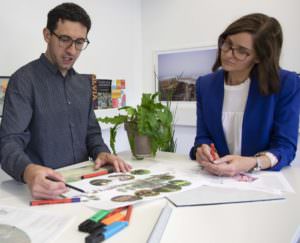
It provides a series of standards that draw together policy and best practice guidance to assist developers and built environment professionals in the delivery of well-designed green infrastructure and multi-functional open spaces.
There are two types of awards, one suitable for planning stages, and one for when schemes are built out. It is a high bar to attain this award and demonstrates the dedication of the whole team and high quality of design and collaborative approach to designing green spaces for people and nature.
For more information either contact Building with Nature or EDLA team members Michael or Eleanor
This page tells you more Building with Nature Assessor Accreditation
Three women, all Owner/ Directors of Landscape Architectural practices, answer six questions about what it’s like to be a woman in this industry.
Interviewees:
Eleanor Trenfield (ET) is the Owner/ Director at EDLA
Wendy Lancaster (WL) is a Landscape Director at Tyler Grange
Catherine Xavier (CX) is the Owner/Director at Guarda Landscape
Q1
International Women’s Day calls for a gender-equal world. A world that is diverse, equitable, and inclusive. A world free of bias, stereotypes, and discrimination. The premise is that the world is not gender-equal. Is this right? What does this vision say to you?
ET: The world is not gender equal, but from my own experience, this is changing. I was brought up in the belief that I am no different in talent or ability than any man, and my parents encouraged me to achieve academically. This is a big shift from my mum’s experience just a generation ago, where her brothers were sent to university and she was sent to secretary school at 16 and encouraged to marry. I am not interested in being known as a female landscape architect, I am a Landscape Architect, full stop.
WL: Yes, I absolutely agree. Both women and men are subject to expectations on the way they should behave. The vision is where we should be, not just for gender, but for sexuality, race, and any other differences.
CX: I am the first generation where women have had the opportunity to choose jobs available to men and live a free and prosperous life without a man. Before there was complete gender bias, where men were the breadwinners and women stayed at home. My mum speaks about the lack of choice, sweeping assumptions and discrimination in every institution. Although women over 21 gained the right to vote in 1928, as late as the 1970s working women were refused mortgages because few were employed continuously. They were granted mortgages only if they could secure the signature of a male guarantor.
Equality has moved forward quickly since then and in the 30 years that I have been in the industry I have started to see women around the table, especially in architecture, planning, arboriculture and ecology and even engineering is seeing a surge in female representation. We are moving towards a more equitable world (or certainly the world that I inhabit), but we have some way to go before we can claim complete diversity. The same is also true of other minority groups and those who come from deprived backgrounds.
The vision is for everyone in the world to have choice and opportunity, regardless of who they are or where they come from. If they have a dream, they should have the opportunity to reach out and take it.
Q2
As a Director of a Landscape Practice, you are one of a small number of women in senior roles in our profession (outnumbered by more than double at senior level). What, if any, obstacles have you faced, and do you consider any of them were connected to you being a woman?
ET: I have been lucky to work in great practices gaining high-profile experience and a strong network. But it became obvious over time that the environment I was in was not supportive of more significant career growth. It was plain to see that men far outnumbered women in partnership roles and this culture can’t help but filter down throughout the business. Looking back, it was the most positive conclusion I could have come to, as I decided to be proactive and build a practice that reflected my values and aspirations.
WL: The expectations on how I should behave and how I should accept being treated, in ways that my male colleagues weren’t. I feel like I’ve been judged against a different set of criteria which has been hard to call out, and then there have been the straight-out instances of discrimination and harassment. I don’t believe I would have experienced those times as a man.
CX: It’s interesting because now I look around and I see a few women who own landscape architecture practices, including our current president, Jane Findlay. However, as I advanced my career back in the 1990’s and 2000’s, I didn’t even realise that I had the opportunity to set up my own practice. It seems ridiculous now looking back, but it just didn’t occur to me that it was an option.
This was due to the lack of role models at the time. Every practice owner seemed to be white and male, and from a well-educated background. I just didn’t fit that mould, being female, mixed-race, and from an inner-city comprehensive. Also, the careers advice being handed out in the 1980s was seriously lacking in ambition (more so for women?) and we were never taught about owning a business or being self-employed. I went to a career fair in London just before the pandemic and the students only wanted to know how to work for themselves. We have come a long way in the last few years.
I remained an employee until I reached my mid-40s and then I finally woke up to the fact that I could do it too, and maybe even better!
Q3.
An article by Romy Rawlings in the most recent LI Journal (attached) references findings from a blog by Robert Holden CMLI, she says, “There’s no problem attracting women into the profession. For salaries up to £50,000, the profession is pretty much at parity and younger women (particularly those without children) may well encounter no issues in the workplace. However, for those earning over £50,000, the situation declines and there is more than twice the number of men than women in this salary band”.
What are your views on this, why do you feel this is the case, and what do you feel are some of the remedies to address the lack of female senior representation?
ET: These issues are complex, and in many cases the data suggests that it is largely connected to a woman’s decision to have a family (not forgetting that there are obviously men involved in this decision too). More financial support with childcare to enable women to maintain their careers, and an acknowledgment within larger practices that a more balanced management board will result in a more balanced and positive business.
WL: There’s a cultural bias, in the way we network and do business. The majority of our clients and the other professions around the table, especially the more engineering and ‘nicely factual’ ones, are still dominated by men. We’re starting to see more women in the construction industry, especially the housebuilders, and more of these are in more senior positions. Creating environments where women can thrive, and supportive and positive practices around maternity leave, for example, positive examples from male and female leaders will all help to encourage women forward to the senior positions. This will reinforce the positive cycle.
CX: I don’t have children and so it is hard for me to comment personally on the Romy Rawlings article. However, taking time out of the profession is inevitably going to have an impact on career progression, for men and for women. If a couple chooses to have children, their priorities change, and parenting becomes a central focus in their lives.
The issue in the past has been that the woman has usually picked up a majority of this responsibility whilst the man is left to have a family and also progress his career at the same time. Society has to change to ensure that both parents take equal responsibility, which also benefits the children as they grow up close to both mother and father.
I also believe that subconscious bias is also another factor at play, i.e. hiring or promoting people that are just like you. I see this all the time and I am guilty of it too. We are naturally drawn to commonality or the familiar and it is basic human behaviour. This is why it is important for leaders to question their choices and even in some situations introduce temporary quotas to ensure that minorities have to be selected until there is some semblance of parity.
Q4.
Have you ever called out inequality or bias (unconscious or conscious)? Professionally or personally. Talk to this. If not, what do you see as one of the biggest issues in achieving a gender-equal society?
ET: Yes, I have called out bias and inequality but not as much as I should have as I was concerned that it would harm my career. I remember once raising something that really mattered to me personally about a situation at work, and it being brushed off because I was one of the ‘strawberry generation’, i.e. a sensitive female millennial who bruises easily. If you are brushed off when you raise something that matters to you, the chances are that you won’t raise it again. I have been put in extremely awkward positions in a forum of clients and consultants being asked when I am starting a family and ‘not to leave it too long’. And some have openly discussed women in their teams and their fertility. If I may give some advice here, this is not a subject area any woman is comfortable talking about within a professional environment.
WL: Absolutely, both in my earlier, pre-professional career and since I became a professional and, it’s been much harder. I found the more obvious sexism in my earlier careers easier to call out. The unconscious (and conscious) bias I’ve experienced in professional practice has been far more insidious. If I’d felt that there were women in senior roles who I could have gone to, I think the outcomes would have been very different.
CX: I am very aware of subconscious bias. For example, when I first set up the business I didn’t network with, or market to, a certain demographic because I realised that the likelihood of being taken seriously was low. I also enjoyed networking in London as there was greater diversity and so was more comfortable in this setting. I also met other female company owners and we worked united in our approach. All of this has become less pertinent now as the practice has developed an established reputation, although I am still sometimes greeted with surprise when I tell people that I am the only owner-director of the business.
Subconscious bias exists all the time and the only way to minimise its impact on diversity is to have diverse leadership.
Q5.
A new edition of Making Space (first published in 1984) comes with a new introduction from leading feminists that discuss the work’s conclusions that sexist assumptions on gender and sexuality have a fundamental impact on the way buildings are designed and our cities are planned. (Published by Verso in March 2022). Can you talk to this? Does this resonate with your practical experience?
ET: Given that our cities are predominantly governed, planned and designed by males who are from a similar background, I would suggest that it is not just a gender issue.
WL: Greater diversity in all aspects of design, whether it be Architectural, landscape or product, can only help understand the different needs that different groups have. A single group deciding what we all need isn’t going to result in those needs being fulfilled and can be dangerous. I recommend reading ‘Invisible Women’.
CX: I don’t think that gender is the problem. It is a lack of diversity and therefore narrow life experience which has stunted design in the past. We use our experiences to inform our thoughts, ideas and designs and if these are limited then the solutions will be limited. In my experience, the most successful designs are born out of collaboration. The greater the diversity in the team the better the result. Diversity of gender, age, background, health, ability, all bring together a wealth of experiences and therefore promotes true design inclusivity.
Q6.
As senior leaders in Landscape Architecture, what are you doing to #breakthebias? The hashtag and call to action for International Women’s Day?
ET: We foster an open culture in the practice, where people feel safe to raise ideas and issues that matter to them. We have started running networking events that offer something alternative to drinking culture and for those who cannot spare time in the evenings for more traditional networking events to be more inclusive for those with childcare commitments. We are a family-friendly practice and offer flexible working. We hire on talent, motivation and drive, not on gender.
WL: I’m trying to be better, to make sure I don’t perpetuate biases and assumptions about my team. One thing that resonates with me strongly is the way that women are treated before, during, and after their maternity leave. This has led me to consider how my male team members may experience similar or different issues around paternity leave. I want all my team members to feel empowered and supported, regardless of gender, sexual orientation, race or any other difference.
CX: I am proud to be a positive role model for women in the industry and promote female representation in leadership positions. I try to advocate this within GUARDA and also endorse this view through my dealings with our consultants and clients on a day-to-day basis.
I admit that I find it slightly frustrating when I see practices post pictures of their female team members on International Women’s Day when I know that all of their leadership/director positions are held by men. I hope that as the years pass this will change and we will see parity of men and women at the top. Maybe then we no longer will need an International Women’s Day.
Q6(a)
Any advice you would give your younger self / younger female professionals out there who are embarking on a career in Landscape Architecture?
CX: Don’t fall into the trap of thinking that you are not good enough. If you have the passion, desire and determination then you will be great. Surround yourself with mentors/advisors that you trust. Support is important and don’t be afraid to ask. So many people (men and women) genuinely want to help and see you do well.
You will never appeal to everyone and not everyone will like you or want to work with you. Don’t take it personally and just find out what works for you.
Also, starting a practice is a good option for a woman (and men), it is hard work but also offers control, flexibility and the beginning of many rewarding relationships.
ET: Find a mentor. Someone who will support you and help you to navigate the professional world. Preferably someone outside of the business you are in. There are great networks out there, such as Women in Planning which have a mentor training programme and connect mentors and mentees based on criteria. And it’s a personal decision and not an easy one, but if you feel able, speak out when things aren’t right.
WL: I wish I’d known about Landscape Planning as a career when I was doing my geography A levels; I got here by accident but it’s perfect for me. I’d say to all young women to trust your gut, you don’t need to put up with it or stay in a job where you’re not heard. There are great organisations in the industry, such as NAWIC, where you will find supportive and empowering women. We’re an industry short of people, we need to look after our colleagues.
The Landscape Institute is about to launch its latest sector survey which will include an analysis of gender balance and progress within the profession.
American Activist and entrepreneur Eli Pariser said, “To be a good citizen, it’s important to be able to put yourself in other people’s shoes and see the big picture. If everything you see is rooted in your identity, that becomes difficult or impossible.”
This is no more important than when designing public realm spaces, which will be used by all sections of the community, able and non-able body, sighted and non-sighted. The leading charity for the visually impaired, the RNIB, states there are near, ‘2 million people in the UK live with sight loss and this is predicted to increase to 4 million by 2050’.
It goes without saying, that all of our community needs to be able to navigate and safely access all the amenities and public areas. But this is not the case for a number of reasons.
Recently, the EDLA team was privileged to receive a talk from Consultant Matt Datson, on his experience navigating space and public transport as a severely visually impaired person. His perspective was based on his hometown of London, but universally applicable.
One of the observations that most resonated was the disclosure that Matt avoided many large and familiar public areas, such as Kings Cross Station or Oxford Street. Any noisy or busy areas where there is not a clear designated path for him to follow, or where he cannot hear enough to get his bearings, is a huge challenge for him.
Matt offered some helpful insight into design features on what makes that experience easier and what doesn’t.
Design features that Matt felt were useful and relatively common:
On the other hand, the following things are not as common, but which would be really helpful.
However, there are spaces that Matt said he felt unsafe/are difficult for him to navigate and therefore he avoids.
These include large open spaces with few distinguishable features to navigate by and pavements that are of poor quality or where there are obstacles such as bins which he can trip over. He mentioned that residential pavements are particularly hard to navigate on bin days, and he has had falls over rubbish bags and bins where they are unexpected on his routine route.
Is it acceptable in modern Britain, for a huge cross-section of the community, including the elderly, to not use areas of our cities, because they do not feel safe to use? Primarily because the space does not facilitate their needs.
Simply, no. We believe as designers of space; we have a responsibility to be taking cognisance of the needs of people with a visual and/or mobility impairment in our thinking when creating proposals for new projects.
The key takeaways our team took away from Matt’s talk included:
Some interesting work being done in this field include the ‘Feel the View’ car window by Italian Innovators, ‘Aedo’, which translates landscapes onto a tactile display and lets blind people ‘see’ the landscape along the journey. The company has come up with software that will translate the view of the landscape onto a tactile panel, which the user can then feel and hear to experience.
How can Landscape Architects use software to help people ‘see the space’ of their surroundings better?
Matt’s talk was interesting on many levels, but it was his last comment that left a lingering note. Matt asks that sighted people or able-bodied people approach disability with more openness and ask questions. He wants people to see him as a ‘person’ first, before seeing his disability.
Perhaps we all need some help sometimes to see things clearly.
If you are interested in booking a session with Matt Datson, please contact Jo on office@edla.co.uk and she will put you in touch.
Looking back whilst on the cusp of moving forward into a new year is always interesting. In the momentum of busy working days which quickly turn into months, it is easy to forget all the things that have been done, all the decisions made, jobs won, and schemes submitted. But it is important to take a purposeful pause and reflect, to see the year from a new perspective. Eleanor takes this opportunity to do this in the last blog of 2021.
Overall, it has been a wonderful year, filled with a lot of energy and fun. But most of all significant hard work and dedication by all our team across a huge portfolio of varied and interesting projects, that have allowed us to realise our vision to create sustainable and inspiring places with purpose.
We have had the pleasure to work for nationally known clients such DHL, the Epilepsy Society and the Land Trust, as well as smaller practices who are on their own growth curves, which is exciting to see and means our working environment is dynamic and fluid as we respond.
The majority of our work has been through repeat clients and acquired through word of mouth, which delivers on our strategy of sustainable growth, (100% of our clients who fill in our satisfaction surveys say they would recommend us.)
We have been fortunate to have worked across both rural and urban landscapes on commissions that celebrate the life in these spaces. Projects including country parks, retirement living schemes, tall building assessments, former quarry sites, crematorium landscape, NPPF para 80 homes, a former hospital site, an old flour mill, the regeneration of a rail station urban realm and a Roald Dahl trail in the Cotswolds.
Other projects have also included a huge lake project, urban realm and podium gardens in Croydon and Bromley and strategic residential development sites in the south-east. Plus, a garden city, where our work was stated as ‘pushing standards in design.’
We have been involved in numerous public consultations (online and more recently face to face), many design review panels including for our Ebbsfleet schemes.
I was appointed onto the South East Design Review Panel teaching landscape workshops and now run tutorial sessions for architecture students on landscape. This is important to me personally, as the sustainably of the profession requires more landscape architecture graduates coming through the pipeline.
Following the first Covid pandemic, we have seen a noticeable change to our landscapes through an increased interest in rural tourism in the Kent, Surrey and Sussex area, with a subsequent surge in enquiries to support clients on these exciting opportunities.
Following the first Covid pandemic, we have seen a noticeable change to our landscapes through an increased interest in rural tourism.
We have also seen site representations to local plans requiring increased detail, including upfront LVIAs even for smaller sites and a number of local plans unfortunately failing to be found sound.
We have collaborated with landowners looking ahead to implement advanced planting on strategic sites and we have welcomed closer collaboration with ecologists in light of Biodiversity Net Gain. We are also having ongoing discussions with ecologists on how to make natural places function for people and wildlife, included supporting a local community Neighbourhood Plan with landscape evidence.
We have welcomed closer collaboration with ecologists in light of Biodiversity Net Gain. In terms of our living our own mission, ‘To create wonderful, sustainable spaces, which are sensitive and respond to surroundings and wildlife. To be a business that balances profit with purpose,’ we are on our way to Certified B Corporation status and continue to develop our internal sustainability audits to use on every project (aligning with SITES methodology). In addition, we have invested in more electric vehicles for our team and moved to Canterbury city centre, to make accessing public transport easier.
To reflect back and see all the positive work and difference we are making and the team that we have created and nurtured, I am immensely proud.
Donald and I were both appointed as Design Council Experts. We also supported two landscape students during the year who were doing their BAs with financial contributions and paid work experience.
Our team gained two new team members, lost two team members through relocations and, in recognition of our continued growth, we are recruiting for a new Senior Landscape Architect. We have invested in a new drone for aerial photogrammetry for our clients in the new year and were successfully granted generous funding from LOCASE (Low Carbon South East) for SME business growth.
To reflect back and see all the positive work and difference we are making and the team that we have created and nurtured, I am immensely proud.
Our new branding is in progress, and we will soon be unveiling our new website. When I started the business over four years ago, it was a daunting but exciting step. To reflect back and see all the positive work and difference we are making and the team that we have created and nurtured, I am immensely proud.
A particular thanks to my co-director Donald who is an inspiring person to work alongside, our practice manager Jo who supports our team in every way imaginable, enabling us all to do what we love and the incredible EDLA team who show up every day dedicated, enthusiastic and full of ideas.
Thanks also to our supporters, contributors, consultants, clients, team members, partners, and families. It feels fantastic to end the year on such a strong footing, ready for more in 2022.
The government is aiming for UK net zero emissions by 2050, and landscape architecture will play a pivotal role in achieving this ambitious target. This ambition will require not only short-term design solutions but long-term design response that will challenge current landscape design aesthetics and approaches. This will alter how public realm is designed and ultimately impact all aspects of our lives, from what how and what we choose to eat, how we travel and how we expand and maintain the cities that we live and work in.
Cities will undoubtedly be at the forefront of climate action and the transition to a carbon-free economy in the UK and beyond. Currently cities account for around 76 percent of the world’s carbon emissions and 75 percent of total global energy consumption, meaning that they have the most to gain from cleaner energy and a greater responsibility to act now, galvanising the change needed.
One such pioneering scheme is the central London Ultra Low Emissions Zone (ULEZ) scheme, which was launched in 2019. The ULEZ to improve Londoners’ health by cleaning up the capital’s toxic air, by requiring all drivers (commuters or residents) to meet strict emissions standards or pay a daily charge of £12.50. The scheme is set to be expanded later this month (October 21) to cover a single larger zone.
One year on the impact has been significant, with ‘65.3% of Londoners changing their mode of transport’, according to a recent survey. The biggest shift was seen with people using a bike or walking. The expansion of the scheme will only lead to more people having to find a sustainable way to get where they are going.
Within the built environment Landscape Architects can allow these changes to be facilitated easier by creating spaces conducive to sustainable travel. We can plan and design urban, walkable communities that reduce emissions from transportation. And through the beauty of the spaces, naturally encourage urban people to adapt a greener mindset.
We are well equipped and qualified to solve design problems with the tools of nature and have the advantage of being able to synthesise nature into urban environments. Good urban design is capable of blending the built into the natural environment, creating cleaner, more habitable cities.
Landscape Architecture provides the greatest benefit to public realm, by designing with adaptation and mitigation in mind. By designing and responding at both global and local scales, Landscape Architects can consider natural processes, such as the movement of water, groundwater, soil, habitats, animals and the increasing effect of climate change on each.
We have the skills to make the built environment more energy and carbon efficient with strategies like green roofs, water-efficient design, and use of sustainable materials and construction practices.
At EDLA, we are committed to developing landscape proposals that are integrated into a wider framework of public spaces.
One such scheme is the Neighbourhood Green project within the wider Ebbsfleet Garden City. A colossal, visionary and benchmark placemaking project on the banks of the River Thames in Kent. Ebbsfleet will offer a green and healthy place for up to 30,000 people to live, work and play, with plans for over 15,000 high quality new homes.
ETLA was the chosen Landscape Architectural practice to prepare the landscape and public realm strategy for the ‘Neighbourhood Green Community Hub’. An important public space and the central communal space for the increasing number of residents in the area.
It important that the space could facilitate and be of interest to all people, of all backgrounds, abilities and ages. The underlying principles for the project centred around the integrity and balance of the quality of life (especially in light of the new covid patterns) and the quality of the natural environment.
Public realm should always be designed to contribute to the overall character of the development. As we proposed with Ebbsfleet Green, our designs integrated within the context of the surrounding developments, to create a lively, diverse and safe series of places where people will want to visit, stay and grow in.
Some of the key aspects of our strategy included integrating the Ebbsfleet healthy Newtown concepts, which include ‘improved health outcomes, better housing, education, employment and environmental opportunities environment’ for all which we encapsulated in semi-sheltered spaces with dense tree canopies for a parent to wait while they collect their children and open space for events. And the edible Ebbsfleet concept, which we embraced by conceptualising fruiting trees and shrubs for children forage on their way to school.
All of which considered sustainable design approaches in order for the development to target a Breamm excellent rating.
Once the public realm is understood as a conduit for humankind’s interaction with nature, it is put at the forefront of climate action in our cities and towns.
It has been a longstanding concept in architecture and planning that cities, like humans, are living, breathing entities. In practice this is achieved by creating green corridors that link together existing external spaces, people and biodiversity.
Using landscape architecture to create an urban mosaic of habitats and typologies, public realm can be reimagined. Dense planting and urban forests offer essential sources of carbon capture, while storm management systems can be used to recapture water’s historic role within cities.
Landscape Architects are already playing their part in this climate emergency, what we need now is for everyone else to catch up.
A version of this article was first published in the Architects Journal in 2018
Georgia Timpson, our Graduate Landscape Architect has a background in Environmental Science and shares her knowledge on traditional orchards and how they these havens can connect us to our cultural past.
What are Traditional Orchards?
September is the interim between summer and autumn and as the landscape changes from one of growth to dormancy, one of the areas that are undergoing the most change is fruiting orchards.
Traditional Orchards were once a common sight within rural England, with low-density planting of a wide combination of fruiting trees often found around farmhouses or villages.
These areas would have provided shelter for livestock, alternative income for farming communities and a wide range of fruit for local families including now less common apricot, medlar, peach and quince trees. Orchards are of course, still an integral part of the make-up of the rural British landscape, and September ushers in the harvesting period which still affects the demographics and travel habits of a vast number of rural communities.
An influx of workers from home and abroad to fruit-growing farms is a migration that has occurred for hundreds of years. During the rapid growth of Kentish fruit farming in the late 19th and early 20th century, newly built railways allowed workers from London to flock to the orchards of rural farms to help bring in the harvest.
The area referred to as ‘The Garden of England’, continues to be a hub for fruit growing today.
The National Fruit Collection is kept at Brogdale Farm, close to Faversham and is still home to one of the largest fruit collections in the world with over 3,500 varieties kept.
Throughout Kent, the landscape is shaped by large commercial orchards growing for domestic and international markets. Traditional orchards, however, are an ecosystem all of their own.
‘Traditional Orchard’ refers to the low-density planting of vigorous rootstock varieties of fruit and nut trees, often managed in a low-intensity way on permanent grassland.
Not only do these orchards provide key habitat for native flora and fauna, they also help to reinforce landscape character within rural and heritage farming areas.
They are a designated priority habitat owing to their ability to attract and support an abundance of wildlife. This is because they are a mosaic habitat, meaning they encapsulate a number of different micro-habitats within them. In a traditional orchard, there may be, pasture, meadow grassland, wood and scrubland as well as being edge by mature and dense hedgerows.
Alongside this abundance of habitat choice, the grassland is frequently unimproved and there is minimal usage of herbicides and pesticides.
A Case Study: No Man’s Orchard
A peaceful and beautiful example of a traditional orchard can be found in Chartham near Canterbury – it has the unique name of No Man’s Orchard. The name “No Mans” traditionally means that the land overlaps two ownership areas and consequently is not owned by anyone man (or woman). This is supported by the parish boundary, which runs through the middle of the orchard.
The 10 acres of the Orchard is rich with trees, including about 152 mature Bramley apple trees and 45 pollinators (Howgate Wonders, James Grieve, Worcester’s), which were originally planted in 1947. Some of the Bramley’s have even had pollinators grafted onto their tops.
No Mans Orchard is one of the few surviving traditional orchards in the area and protected under the Countryside Stewardship Scheme. It was designated as a Site of Nature Conservation Interest in 1995 and forms part of Blean Woods South SNCI AS/SW/CA 17. It has also been designated as a Local Nature Reserve.
No herbicides have been used in the Orchard for a number of years and no sprays have been used since 1993, so the fruit is now officially organic.
It is an extremely attractive and peaceful space, well hidden from the road by woodland, mostly Sweet Chestnut coppice. It has some of the largest apple trees in the district, with beautiful blossoms in spring and early summer.
The orchard allows members of the public to ‘adopt a tree’, meaning that you financially support the orchard and get to harvest the apples from your tree if you wish.
Connecting us to our cultural and biological past
In short, traditional orchard habitat is a rarely disturbed space that holds the key ingredients for a healthy ecosystem, varied food sources, and a variety of shelters.
Planting choices should be based on the historic and cultural understanding of an area, the planting of cobnuts in Kent is a native and traditional alternative to more commercial species.
By reinstating these species within a landscape, it is possible to regenerate the ecological makeup of a newly planted area.
Traditional orchards can be a successful method for establishing a sense of local community – particularly within sites that have a history of traditional orchard planting, and their management needs careful consideration with the client from the outset.
Orchards can connect new developments with the cultural and biological past of our sites, whilst creating valuable habitat, but their addition should be a thoughtful one, paying care and attention to their future use.
People who live in areas with more green space near them live longer and healthier lives. On the surface, this is not that surprising. But what is more interesting, is how little time and how little space is needed to make a big difference to a person’s life and wellbeing.
Dutch studies reveal that only a 10 percent increase in green space within 1km of a person’s home will translate to an increase of five years of healthy life. Five years!
The finding found that increased green space proximity decreased cardiovascular, musculoskeletal, mental, neurological, digestive and respiratory health issues, which in turn increased life expectancy. The relation was strongest for children and people with socioeconomic status. (Maas J et. al., 2009, “Morbidity is Related to A Green Living Environment”, Journal of Epidemiology and Community Health, Vol. 63 12, pg. 967-973).
And of course, it’s not just the physical health that benefits. Emotional and mental health improved too with access to green environments. A study published in 2019 in Scientific Reports found that spending two hours per week, that’s just 120 minutes in a natural environment, increased health and wellbeing. https://www.nature.com/articles/s41598-019-44097-3
“The results are in- access to green space makes you happier, healthier and smarter. The power of green can never be underestimated.”
Equally fascinating is another study that reveals experiencing a quality natural environment has strong effects on cognitive function such as memory, attention, and creativity. (Bratman, G. N. et al. 2019 ‘Nature and mental health: An ecosystem service perspective’, Science advances, 5(7), p. 0903.)
So, people who had exposure to green spaces had significant psychological benefits and lower levels of poor health. The results are in- access to green space makes you happier, healthier and smarter! The power of green can never be underestimated.
Even more interesting is the fact that the quality of nature experienced mattered. Research published by The Royal Society revealed that green space that was of higher quality, with a healthy ecosystem and rich species was even more beneficial to mental health, than green space with poor species richness. The study found recipients were less stressed and their’ overall mood had increased when they visited green spaces rich with biodiversity.
The results tell that it isn’t enough to just have access to green space, to really maximise the benefits, humans need a complex biological experience. Much like whilst eating an apple a day is great, eating an apple, kale, and avocado salad sprinkled with spirulina will give you even more benefits.
What does this mean for the Landscape Architectural industry? Apart from needing to up my spirulina, it reinforces how fundamental our service and skills are.
Today’s post-pandemic world is a very different one than it was. People’s priorities have changed, with a greater awareness of the importance of good mental health and for many lockdown enforced a new relationship and greater appreciation for nature. For many, being outdoors and interacting with wildlife offered respite, solace and the only pastime allowed.
The Office for National Statistics published a report in April of this year which looked at how our relationship with nature changed during the pandemic.
They say that in May 2020, at the height of the first lockdown, 36% of people responding to the ‘People and Nature Survey’ by Natural England said they had spent more time outside during the pandemic than before.
This rose to 46% in July 2020, indicating people’s interest in nature had increased.
Nature charities such as the RSPB and the Wildlife Trust also reported huge spikes in web traffic during the first national lockdown, as people had the time and inclination to learn more about their environment. Interestingly too, children’s playgrounds and parks which were closed during the first lockdown, had more visitors in the summer of 2020 than in pre covid years, according to Google mobility data for the year.
“People do not want to go back to a green-less existence of before. With many urbanites demanding that whilst their city lives return to normal, the environment needs to come with them”.
Whilst mental health unsurprisingly overall was reported as a decline during the pandemic, studies indicate that people’s awareness of the benefits of nature to their wellbeing had increased. Around 9 in 10 people surveyed by Natural England in May 2020 agreed that ‘natural spaces were good for mental health and wellbeing’. More than 40% noticed in general that wildlife and visiting local green spaces have been even more essential to their mental health since the restrictions started.
So where does that leave us? As the world embarks on a post-Covid recovery plan, Landscape Architecture has never been more vital. People do not want to go back to the green-less existence of before. With many urbanites demanding that whilst their city lives return to normal, the environment needs to come with them.
A new survey entitled ‘Nature positive?’ by environmental consultancy WSP and independent Thinktank Bright Blue, shows that the UK public wants nature at the heart of policymaking. With ‘nearly three-quarters (74%) of the public polled supporting a requirement for developers to enhance the natural environment when building new houses’.
Whilst ‘72% of the public would be more likely to support new infrastructure development if the organisations constructing them are obliged to materially improve the local natural environment’.
The report found strong public support for new housing and infrastructure developments so long as they improve the natural environment. There was also support for the ‘biodiversity net gain principle’ included within the Environment Bill, which requires developers to ensure that the natural environment is left in a better state than before.
It is common sense that we feel better in nature and benefit from being outdoors in the landscape. But the hard stats also overwhelmingly support this, and it is our duty, as Landscape Architects, to bring this to the forefront of every project we work on.
by Eleanor Trenfield (EDLA Director)
Why are young people not entering our profession? Or a more interesting question to ask is how many Landscape Architects does our economy need?
If we can understand the latter, we can then perhaps work on addressing the former.
Landscape Architecture is a beguiling mix of biology, engineering, science, art, and sociology. A Landscape Architect has to be creative yet strategic, visionary yet practical. They hold in their hands the ability to mitigate against the toil on the environment that centuries of overdevelopment, industrialisation and urbanisation have caused. Which in turn has affected the psychosocial wellbeing and health of generations.
Landscape Architects in the UK, have a vital role in helping the Government achieve its ambitious 2050 net-zero target, and it’s not an exaggeration to say that the profession is key to addressing the climate emergency.
Indeed, according to this US student career site, over the next 10 years, Landscape Architects will be one of the fastest-growing occupations, with a projected 16.4% rate of growth during this time period (2018-2028).
The profile of Landscape Architecture has in many ways never been higher, as Landscape Architects are being called increasingly to play a significant part in residential developments, placemaking, urban design or reimagining city projects.
Landscape Architects like never before have a seat at the table and this time are there for all the courses. Rather than just for dessert, as was the way in previous years.
“Landscape Architects like never before have a seat at the table and this time are there for all the courses”
Nobody doubts, that what the world needs now, is innovative green architectural solutions that achieve aesthetic, modern living outcomes whilst ensuring environmental sustainability.
In the urban context, landscape architecture is sometimes confined to the ‘creation of life between buildings.’ But it’s so much more than the bits around buildings.
As copious and comprehensive research studies have shown, humankind needs access to nature to thrive and survive. It’s simple but of course complicated.
So that said, why are generations of eco-aware, politically astute, Greta Thunberg informed young men and women not flocking to become Landscape Architects?
In 2018, the Landscape Institute launched an awareness campaign to try and address this issue. Its #chooselandscape campaign focused on raising awareness of the landscape profession amongst key groups, including pre and Post 16, current university students, and those looking for a career change.
They launched a website, social media campaigns and YouTube videos to entice people to choose landscape as a career. One of the key facets was the introduction of new Apprenticeship programmes and accredited courses at more Universities. How successful has it been?
It’s difficult to say as the campaign is ongoing. But in 2019, the Home Office confirmed that the UK Government had added Landscape Architects to the Shortage Occupation List (SOL). Being on the list offers advantages to circumventing certain restrictions to advertising and employing people from both within and outside the UK, amongst other things.
The Landscape Institute also includes the skills shortage in its lobbing priority 12 key asks document.
The document asks the government to ensure, that ‘access to the skilled and graduate workforce needed for landscape must be a priority for the new government’. (“Landscape Institute | December 2019 12”).
Despite this, Gabby Spencer, a 20-year second-year student of Urban Landscape Architecture at Ravensbourne University still believes the problem is awareness.
People, she believes, especially young people, don’t know what Landscape Architecture is or what its people do. As Gabby puts it, ‘When I tell people the course I’m studying, people are interested but the first question is ‘what is that?’ Gabby only found out about her degree course through a friend who was studying garden design.
She said she had to do quite a lot of, ‘YouTube research to understand what it was that Landscape Architects did’. She also feels that the ‘profession is shadowed under Architecture’.
If awareness is the issue, the solution is to try and get in front of young people, their parents and other key influencers such as Information and Guidance Advisors earlier, as career choices are often made from a very young age.
By Year 10, school students are being encouraged to choose their post-primary choices, whether that be A levels, BTECs or Apprenticeships. To really impact the career aspirations of the next generation, it is important to be there at there as early as possible in their school career.
From little acorns grow big trees, and it is the same with sparking the imagination of young people deciding what they want to be when they grow up.
This is one of the reasons EDLA offers work experience placements to young people, and Eleanor has also attended careers days and spoken at schools to persuade young people interested to think about our industry and why.
Gabby, who is quoted above, recently spent some time within our practice as part of EDLA’s Student Support scheme in partnership with Ravensbourne University. The placement saw Gabby, along with fellow student Aliyah Chaumoo (21), enjoy a two-week paid placement within our studio, in addition to a small grant that will assist them financially with their studies.
Aliyah sums up the point of the experience when she simply said, “I really enjoyed learning from the people I was working with”.
EDLA also works with local schools, offering career talks, workshops, and competitions to persuade young people interested to think about our industry. As Gabby explains, ‘With the climate emergency raging around us. Now is the perfect time for people to choose this path.’
‘With the climate emergency raging around us. Now is the perfect time for people to choose this path.’
EDLA Director Donald Roberts also mentors’ university students at his former University, Kingston.
Eleanor and Donald both run workshops and tutor at the University for the Creative Arts in Canterbury, which is where Eleanor studied her BA in Architecture and was first exposed to Landscape Architecture. “This was a lightbulb moment for me, realising that there was a profession which focused on exactly what I was interested in, but I was never aware of it through school and was encouraged by my parents to do architecture as it was creative, challenging, and academic. Straight out of my BA, I applied to a landscape practice, accepted the role and I have never looked back”
Donald and Eleanor both agree, ‘We, Landscape Architects, are the superheroes of today, we just need to show young people what this looks like, and how they can be part of it. We need our profession to be more vocal and all get more involved in spreading the word.’
Donald Roberts and Eleanor Trenfield (EDLA Directors)
As most children return to school this week, and weary parents who have spent weeks juggling work deadlines, video meetings and parenting rejoice, we turn our focus to the importance of play. Or most specifically the importance of outdoor space for children to play and grow within.
As Australian play expert, Imogen Whittle writes in her blog, ‘nature play significantly improves all aspects of child development – physically, cognitively, socially and emotionally. It develops resilience, confidence, self-esteem, and creativity.
Similarly, Annie Wallen in her research summary for Informal Science, ‘Nature Play is Important for the Cognitive Development of Early Learners’, states ‘spending time in nature is essential for cognitive development. Nature play stimulates creativity and problem-solving skills integral to executive function development. Children who play and spend time in nature have increased concentration and cognitive skills, including mitigation of ADHD/ADD symptoms’.
We know that outdoor play encourages a joy of movement; develops fine motor skills, nurtures untamed imaginations, inspires bravery, builds friendships, and promotes acceptable social behaviours. Plus encourages an understanding of habitat and the need to look after it.
All the characteristics needed to create a foundation for a positive future society.
On the other hand, children who don’t regularly participate in outdoor play can encounter multiple problems.
Richard Louv, American Journalist and social commentator wrote in his 7th book, ‘Last Child in the Woods: Saving Our Children from Nature-Deficit Disorder’, children disconnected from nature, were suffering from an illness. Symptoms of this ‘illness’ (as outlined by Louv, 2005) include ‘depression, hyperactivity, boredom, and loneliness. It may also result in reduced motor development and diminished mental and psychological health, including lack of attention, learning ability and creativity’.
As Landscape Architects our role is to provide, protect and sustain environments for the future. Much as a parent’s role is to protect and provide a future for their children.
Our profession has a unique plurality of focus, as we design in consideration of the wellbeing of the environment and the wellbeing of humanity. This interdisciplinary view allows us to guide our clients through the journey of biodiversity net gain (BNG). As well as creating places that make people happy and tell stories.
Nevermore is this more important when we are designing spaces to enthrall children. Spaces that require us to think and feel like children and fire up our own ‘untamed imaginations’. We always try to adopt a child’s perspective on our architectural decisions and use our creativity to create spaces that connect with them. And in turn, connect them to the outdoors and all the benefits that nature offers.
One fundamental to us is we believe play areas that win children’s attention, need to be daring and imaginative.
One such scheme where this is evidenced is Commissioners Road, in Strood. We were commissioned to design a wide array of public open space, with a wealth of green and blue infrastructure, design terraced public links between two key spaces, and several creative play areas. The play took the form of a dedicated play space with nuggets of play dispersed across the scheme, like a crumb trail to lead the kids to the play area.
The scheme connects nature to new homes for people and children in the area by using the existing topography to create a site-specific response to play.
It was crucial to design a space that was inclusive and provided play equipment of value for every visitor, regardless of age or ability. In addition, this play space would work in tandem with an existing play area adjacent to the site. So, the brief was to not duplicate but extend. Some of the additional features include:
Another concept for a playscheme currently being designed sees an elevated play structure that had several pieces of equipment connected to it, each being sequentially harder to navigate. We thought about how a child may interact with the space and how a canopy overhead could create a feeling of privacy and independence. No child on earth doesn’t like a secret den, where they are king and queen!
In many of our schemes, we have the ability to factor in play spaces. Safe outside play areas for our urban children to enjoy, car-free zones for cycling and walking, woodlands and connected green areas, that encourage children to romp and explore.
All design elements that both serve our youngest humans and may increase the biodiversity gains that can be achieved. Whilst individually these gains may be small, when aggregated across a site, could provide a contribution to achieving a net gain overall. As well as the obvious benefits to all the residents, big and small.
It could be argued that designing spaces for children and designing spaces for sustainability could be one of the same thing if these spaces are looked at with a duality of focus.
The important point is an acceptance that child-friendly planning and design is not an extra consideration but one that should be central to schemes and sustainability goals. Adoption of this approach could help a project succeed.
On top of offering a solution to the eco-crisis, we are all responsible for trying to mitigate and ensure there is a planet for our children to grow up in. And the children who grow up are happy, healthy, and mentally resilient.
Next Page »« Previous Page