
We'd be interested to hear about your projects and ideas, do get in touch.
 ETLA Home Page
ETLA Home Page
ETLA Home Page
Location: Remote or Canterbury (flexible)
Job Type: Full-time or part-time
Salary: Competitive, based on experience
Design with purpose. Shape landscapes that connect people to nature.
At EDLA, we design places that bring people closer to the natural world. We’re an award-winning landscape architecture studio based in Canterbury, known for thoughtful, people-first design across the south-east. Our work ranges from Millwall FC’s training ground to rooftop gardens in London, new parks, play spaces, and a surfing lagoon at Betteshanger Park.
We are looking for a Senior or Associate Landscape Planner with strong LVIA experience and the ability to support and advise on complex planning contexts, particularly for sensitive or designated landscapes including Green Belt sites. This role offers the flexibility to work remotely or from our Canterbury studio, and can be full-time or part-time.
• Lead and deliver LVIA and landscape planning assessments
• Prepare written representations and Expert Witness reports (written and/or oral)
• Advise on planning strategy for sensitive or constrained sites
• Collaborate with internal and external design teams
• Significant experience in LVIA and landscape planning
• Strong working knowledge of Green Belt and rural policy
• Experience working with sensitive or designated landscapes
• Expert Witness experience (preferred)
• Excellent written communication and report-writing skills
• Based in the South-East or able to travel for site visits
We’re a small, collaborative team who care deeply about design quality, nature, and people. We support flexible working, shared learning, and a good work-life balance.
Everyone contributes across the studio and we value openness, initiative, and a willingness to learn together.
We actively support each person’s growth within the business. Every team member has access to an individual training budget, and we cover the cost of professional memberships and chartership fees (including Landscape Institute membership and accreditation routes).
• Competitive salary
• 28 days holiday plus your birthday off
• Additional day’s holiday per year after two years’ service (up to five extra days)
• £1,500 annual training budget
• Landscape Institute membership and chartership fees covered
• Private dental care
• Two Charity Days per year
To apply:
Send a CV and portfolio (under 10MB, max 20 pages) to office@edla.co.uk
Applications close: 25 August 2025
Director Eleanor recently participated in the Architects Climate Action Network (ACAN) Biodiversity Net Gain (BNG) in Practice seminar, an engaging online event where experts explored how to effectively implement BNG in practice.
During the seminar, Eleanor shared insights from EDLA’s work on BNG across small, medium, and large strategic scale greenfield projects—highlighting the unique challenges and opportunities each scale presents.
The introduction of mandatory BNG earlier this year is reshaping design practices across the industry, and it’s clear that it’s crucial to actively integrate these requirements into our projects.
The panel also featured industry leaders, including Gary Grant from the Green Infrastructure Consultancy, who discussed innovative green roof designs for biodiversity, and Joanna Asia Milewska from LDA Design, who guided attendees through a Lee Valley Ice Rink project where ice rink scrapings were repurposed as fresh water source to support habitats for species like water voles.
With BNG now a key requirement for new applications in the UK, it’s an exciting time for the industry as we explore how to not only meet but exceed these standards. The conversation continues, and we look forward to implementing the inspiring design solutions shared during the event.
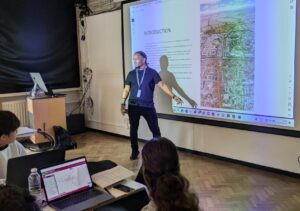
Our directors Eleanor and Donald recently enjoyed leading a landscape workshop at the University for the Creative Arts (UCA) for second-year BA Architecture students.
The workshop helped foster an appreciation for the intricate relationships between landscape, architecture, and place. The immersive session guided students in developing a deeper understanding of their sites through soils, character, heritage, and ecological potential—all essential elements in creating thoughtful, resilient landscapes.
At EDLA, we are committed to nurturing the next generation of architects and landscape architects by sharing our expertise and championing a landscape-led approach. Thank you to UCA for hosting us, and to the students for their enthusiasm.
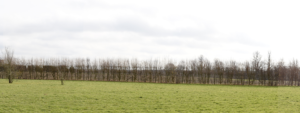
As autumn’s vibrant colours fade to winter greys, now is the ideal time to consider winter photography for your projects. These images are invaluable in capturing the ‘worst case’ visibility for your Landscape and Visual Impact Assessment (LVIA). The optimal window for winter photography is typically from December through early March, once trees are bare. For projects needing ‘Verified Views,’ advanced planning is key.
Why Winter Photography?
Winter photography is essential for Landscape and Visual Impact Assessments (LVIA), revealing a site’s ‘worst case’ visibility and enhancing assessment robustness. It also captures the contrast between summer and winter, illustrating the seasonal dynamics of a landscape.
Best Conditions for Winter Photography
For the best results, winter photography should be scheduled once leaves have fallen, typically from early December to early March. Ideally, the weather should be crisp and clear for good visibility, but finding a suitable day can be challenging during winter’s often grey, misty weather.
We also recommend allowing time to confirm viewpoint locations with the Local Authority beforehand, should they require specific additional viewpoints. Our team can manage this coordination for you.
Need Verified Views?
For projects that require ‘Verified Views’ or ‘Accurate Visual Representations,’ additional steps are involved. These representations typically require both a photographer and surveyor on-site together, and due to their complexity, planning in advance is essential.
Summer and Winter Views for a Comprehensive LVIA
For sensitive sites or complex schemes, we recommend capturing both summer and winter views to provide a complete visual assessment. All photographs are taken from publicly accessible locations and follow the Guidelines for Landscape and Visual Impact Assessment 3 (GLVIA3).
Get in Touch
If your project requires a Landscape and Visual Impact Assessment, we can help schedule winter photography in advance, ensuring it’s available for use throughout your project timeline. Contact us to discuss your needs.
By Kate Astbury, Junior Landscape Architect
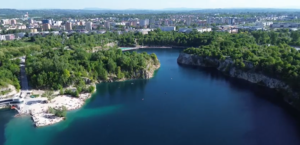
“Recently, I had the opportunity to visit Zakrzówek swimming pools, a former limestone quarry near Kraków, Poland that has been transformed into an oasis. It was a perfect example of how thoughtful design can balance accessibility and safety while allowing people to connect with nature in an unforced, authentic way.
A Hidden Gem: Limestone Quarry Turned Oasis
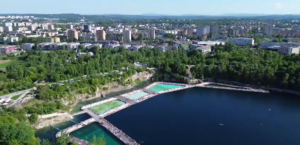
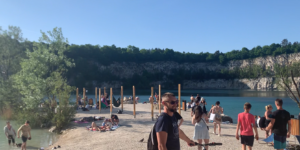
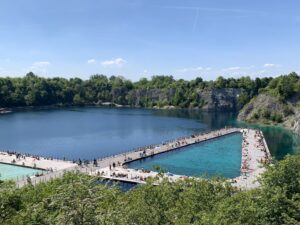
I try to immerse myself in nature around my birthday each year, and this time my partner and I explored Zakrzówek—a beautiful lake encircled by hiking trails. What stood out immediately were the floating swimming pools, ranging in depth from shallow ponds for children to deeper pools for adults. These pools added a layer of accessibility and safety to what was once a dangerous spot. It was impressive to see how this unregulated swimming area had been reimagined into a space where families, locals, and visitors alike could relax and enjoy the environment.
Whilst wandering through the trails, we discovered hidden play elements like swings and ping-pong tables, creating a sense of playful discovery. The site was largely frequented by locals, which gave it an intimate charm. Families, children, and teenagers were scattered across the area, finding joy in the water and the landscape.
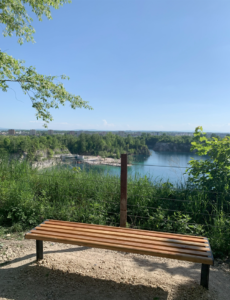
I felt this was a clear example of design encouraging exploration, gently nudging visitors towards moments of delight—whether it be a swing perched overlooking a cliff edge or a quiet spot to take in the views.
Joy of Play for All Ages
Experiencing spaces like Zakrzówek reminds me of the value of playfulness in our lives as adults. The swings, water activities, ping-pong tables, and the winding trails invite us to step away from our daily routines and reconnect with that sense of joy and freedom, which is so crucial for our mental and physical health.
My favourite element along the trails were undoubtedly the swings. There’s something timeless and joyful about them, and their placement within the landscape was so thoughtful. It felt like an organic discovery rather than a planned feature, and it added to the sense of playfulness throughout the site.
Balancing Recreation and Ecology
One of the most admirable features of Zakrzówek is its delicate balance between recreational use and ecological preservation. Educational boards dot the park, emphasising the importance of protecting local flora and fauna. The design encourages playful interaction with the space while subtly steering people away from more sensitive areas. It’s a thoughtful approach, blending enjoyment with a respect for nature.
That said, you could still see groups, particularly teenagers, pushing the boundaries, exploring cliff edges and more secluded spots. There’s a sense of adventure there. The park has a no-alcohol policy, and police patrol during the day, maintaining a safe, welcoming atmosphere. It’s a space designed for community gatherings too. There’s no entry fee, and the openness of the space makes it feel as though it belongs to everyone.
Although parts of the site were still under development—some toilets weren’t open yet—the accessibility was already evident, with ramped entrances to the swimming areas and some hardstanding paths. It was clear they are continuing to invest in making the space even more welcoming and accessible to all visitors.

Engagement Beyond the Ordinary
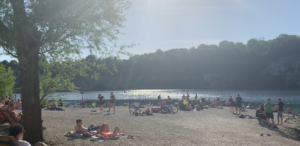
In addition to families setting up picnics and taking dips, there were also paddleboarders and even a diving school that uses the site for training. They’ve found fascinating things underwater—an entire bus, for example. It adds an element of adventure, encouraging people to engage with the space on multiple levels.
Seamless Aesthetics
The aesthetics of the spaces were equally impressive. The use of natural timbers and muted greens and greys in the signage ensured the built elements blended seamlessly with the environment. Even the gravel paths fit well, though some accessibility issues with people slipping were noticeable.
Climate and Community
While there, I couldn’t help but think of the untapped potential in the UK. With the changing climate, spaces like this could come in handy in the UK too. We have reservoirs that could serve a similar purpose, especially for those far from the coast.
I’ve had a similar experience in Norwich on a particularly hot day when we visited a nearby lake. A friend in our group who is Polish pointed out that the Polish community often gather there on a hot day for a swim and BBQ. It struck me that we don’t embrace these kinds of spaces enough and that it is a great idea to utilise our natural environments to improve both our mental health and our connection to our wider communities.
I couldn’t help but think how much more inviting it would have felt with some thoughtful design, much like Zakrzówek. Kraków managed to maintain a natural feel while making the space more accessible and enjoyable.
Room for Growth
While Zakrzówek is a remarkable space, I believe there are opportunities for enhancement. For instance, increasing the number of shaded areas near to the swimming pools would make the site more comfortable during hot summer days, allowing visitors to swim for longer without seeking cover.
Additionally, I would add more toilets as there were extremely long queues to use the limited amount provided.
By addressing these areas, Zakrzówek could elevate its status as a premier destination for all who seek to connect with nature.”
In October, our team focused on the importance of play. To refresh our ideas, our team attended a CPD with Richard Cocker where we explored the value of play from various perspectives. A few stand-out books recommended during the session caught our interest as essential reads for anyone involved in the role of play in our lives.
Here’s a quick rundown:
Each of these works deepens our understanding of play as a crucial factor in well-being, mental health, and social development. Perfect resources to accompany our October theme on play and to inspire inclusive, engaging landscapes.
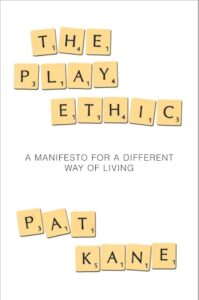
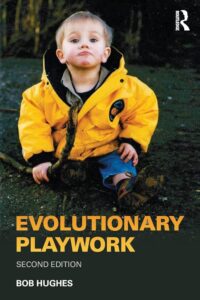
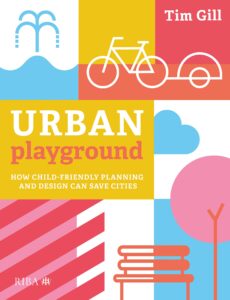

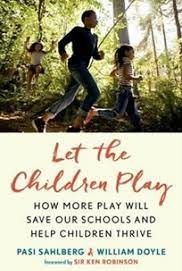
If you’d like a short read on the different types of play, click here.
We design inclusive play areas that cater to children of varying abilities, creating opportunities for social integration and empathy building. Additionally, the mental health benefits of outdoor play—reducing stress and enhancing emotional resilience—are at the forefront of our designs.
Our designs incorporate natural materials and green spaces because we know that time spent in nature improves attention spans and helps children build a connection with the environment. Considering planting within play areas is also important for kids exploring nature as many kids do bug hunts or bug hotels with sticks and leaves along the periphery.
Play spaces also serve as intergenerational hubs, where not just children, but adults and older generations can connect and engage, fostering a stronger community. In our designs, we incorporate six key types of play to foster a wide range of skills, helping children grow, connect, and thrive in safe, natural environments.
Play helps children:
– Build physical and mental well-being,
– Encourage healthy brain development,
– Strengthen creativity, imagination, and problem-solving skills,
– Develop social skills like sharing, collaboration, and communication,
– Build confidence, resiliency, and decision-making,
– Practice overcoming fears and adult roles,
– Explore the outdoors and their senses, learning about the world.
We designed the play area to encourage social, imaginative, and creative play for children of various ages. Using wooden structures, edible landscapes, and planting that connects with the wider site, this space fosters exploration, movement, and interaction. It’s a place where children can develop their physical, cognitive, and social skills while staying connected to nature.

Our play area draws on a range of play types—locomotor, creative, exploratory, and mastery play—designed to keep children engaged and discovering new ways to play every time they visit. With seating for parents and secure, natural surroundings, it’s a safe and stimulating environment for the whole community providing connection between the Primary school and the wider community.

The play equipment with wooden structures will form part of a larger area that will incorporate materials and planting found in other parts of the site, allowing for a feeling of connection and familiarity with the wider site. It allows for children within the site to feel more as if they are within nature, as well as staying in keeping with the overall aesthetics of the development.
Further reading: Play friendly design and sustainability
At EDLA, we are always mindful of the importance of climate resilience in our projects, ensuring that our designs not only meet today’s needs but also help safeguard the future. Investing in resilience now will reduce long-term costs while creating more sustainable, liveable spaces.
Director Donald Roberts, recently chaired an illuminating panel discussion on Placemaking and Climate Resilience at Queen Elizabeth Olympic Park.
The conversation delved into pivotal questions, including: “If you could implement one bold, transformative change today to radically accelerate climate resilience, what would it be—and why aren’t we doing it yet?” The panel’s responses were both thought-provoking and wide-ranging, offering fresh perspectives and inspiring dialogue.
This event also saw the launch of the Queen Elizabeth Olympic Park Landscape and Public Realm Framework, alongside the updated Park Design Guide. Notably, the guide now includes carbon calculations for 10 core materials used in the park, reflecting the increasing emphasis on sustainable practices and climate resilience.
The spaces we design have a profound impact on the mental well-being of communities. Research consistently highlights the benefits of access to green and blue spaces, which enhance not only physical health but also play a critical role in mental wellness.
Access to nature helps reduce stress, anxiety, and depression, while fostering a sense of connection and emotional balance. Studies have shown that time spent in green environments, such as parks and gardens, or near water bodies like lakes and rivers, can lead to improved mental clarity, better mood regulation, and enhanced cognitive functioning.
At EDLA, we prioritise these benefits in our designs. Our approach ensures that every project integrates nature in ways that benefit both individuals and communities. By enhancing biodiversity and creating accessible spaces for reflection and activity, we help support healthier, happier communities.
Discover more about the connection between mental health and nature in our detailed exploration of the Impact of Green Spaces on Mental Health, a science-backed overview of how landscape architecture can promote wellness.
Director Eleanor Trenfield joined an expert panel at the Implementing Biodiversity Net Gain (BNG) in Construction roundtable sponsored by Biofarm. This insightful gathering brought together industry leaders to discuss the successes and challenges of implementing BNG in the construction sector.
The roundtable was an inspiring opportunity to share EDLA’s perspectives and hear from thought leaders across ecology, construction, and environmental management.
Eleanor highlighted the importance of balancing public space enjoyment with meaningful biodiversity improvements – something we’re passionate about integrating into all our projects. She also raised the fundamental importance of considering BNG at the earliest viability stages and within councils’ site appraisal and selection process when identifying sites for growth in local plans to ensure BNG is thoughtfully and appropriately incorporated into development.
Click here for the white paper and podcast for key takeaways from the session including the role of local planning authorities, off-site vs, on-site options, smaller development challenges, maximising benefits to nature from the session.
For insights from our own Kent-focused BNG in Practice Roundtable held earlier this year, read more here.
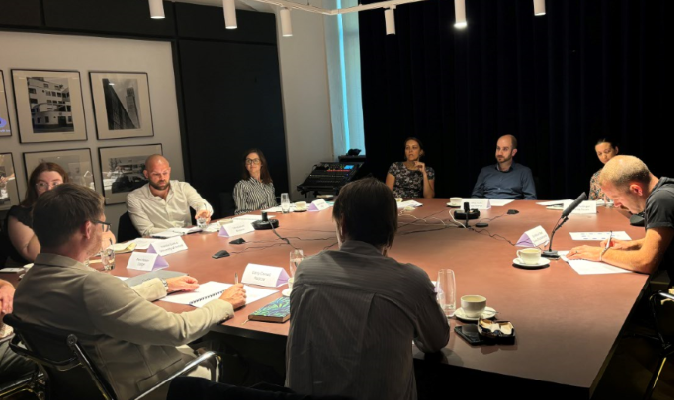
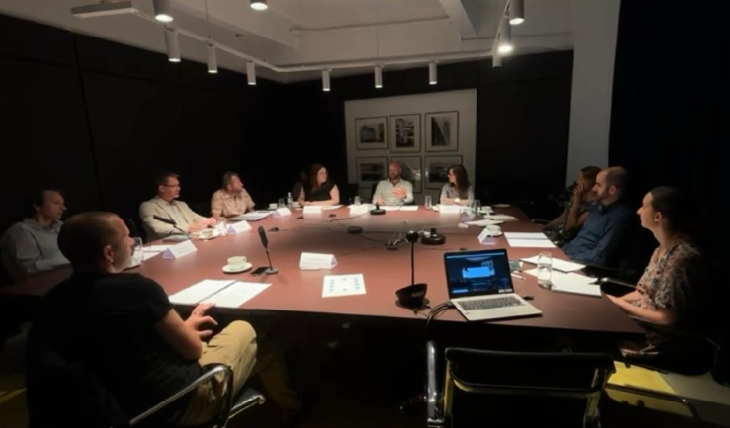
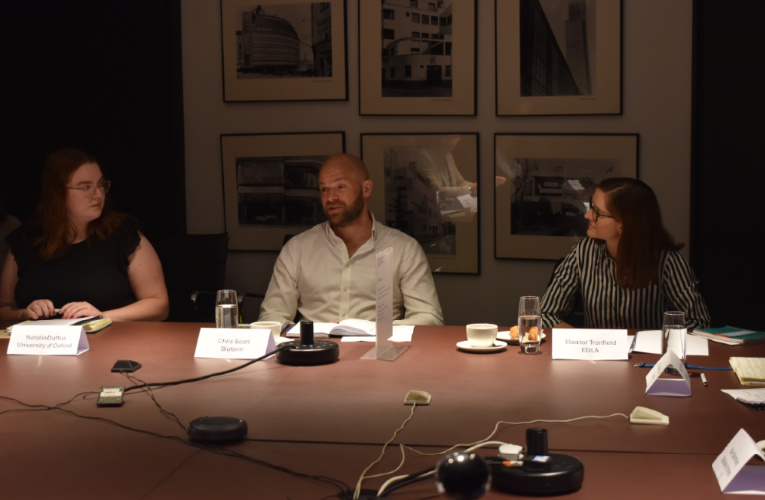
Photo credit: Tailored Round Tables
Next Page »